
From Dal's Front Porch - Fall 2025
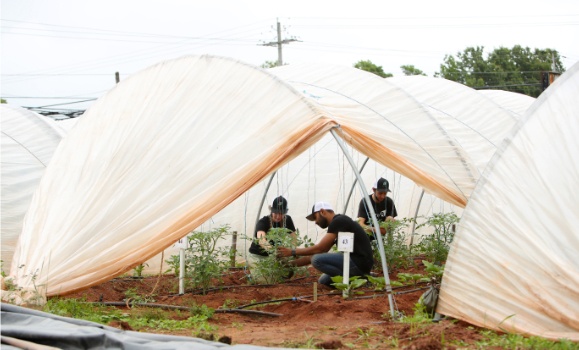
It’s growing season, and Sustain by Cultiv8, a student-run vegetable farm at the Faculty of Agriculture on Dal's Truro Campus, is up and running. Students are not only applying the sustainable agricultural practices they are learning to grow everything from peppers, tomatoes, and greens to fingerling potatoes, ground cherries, and watermelon, they are also selling their produce at their weekly farm stand.
According to Jason Grant (Class of 2011, MSc'13), manager of Cultiv8, hundreds of people from across Colchester County and beyond visit the stand each week for essentials. “We’re giving the community access to locally grown, affordable, nutritious alternatives to more widely available food options that are cheap but not necessarily healthy,” he says.
That appeals to Tena Keefe. In 2024, she signed up for Sustain’s farm box subscription service, which offers a mix of produce in a range of sizes and prices for weekly pickup.
“I’ve been declared disabled because of a head injury, so eating nutritiously is important for me,” she explains. “That’s challenging on a budget. But Sustain helps make that possible.”
Sustain is also addressing food security in other ways. It donates unsold produce to food banks serving the campus and Colchester County, offers subscribers the option to donate their farm boxes to the United Way, and hosts events and workshops to teach agriculture skills to the community. Grant is looking at more opportunities to make a difference, such as the possibility of having donors support a climate battery greenhouse. A climate battery would help regulate temperature and moisture to expand Sustain’s growing season to year-round.
“The more support and focus we can provide to Sustain, the more people we can bring in through workshops, research, and other experiences,” Grant says.

Sustain by Cultiv8 students work on the vegetable farm on Dal's Agricultural campus.
Sustain is also addressing food security in other ways. It donates unsold produce to food banks serving the campus and Colchester County, offers subscribers the option to donate their farm boxes to the United Way, and hosts events and workshops to teach agriculture skills to the community. Grant is looking at more opportunities to make a difference, such as the possibility of having donors support a climate battery greenhouse. A climate battery would help regulate temperature and moisture to expand Sustain’s growing season to year-round.
“The more support and focus we can provide to Sustain, the more people we can bring in through workshops, research, and other experiences. That could mean research that focuses on everything from small farm agriculture and health care to community development and food security. The list is endless." —Jason Grant
Cultivating a Sustainable Future
Cultivating a Sustainable Future
What started out as a space for students to test entrepreneurial ideas has blossomed into a full-fledged student-run vegetable and cut flower production farm at the Agricultural Campus. Cultiv8 allows students to explore their interests and their potential while supporting food security, sustainability and the local economy.
Cultiv8, Dalhousie Agricultural Campus’ sandbox, was launched in 2014 along with five other university sandboxes following the release of the One Nova Scotia Report. This report underscored the importance of entrepreneurship and changing the way Nova Scotia does business to create real change in the province. Each sandbox was established to help students develop entrepreneurial mindsets and to build a culture of innovation, contributing to the ultimate goal of growing the sustainability of small and medium-sized businesses in Nova Scotia.
Cultiv8’s model has evolved since 2014, but at least one thing remains the same: Faculty of Agriculture students get the chance to test the viability of ideas, products and businesses in a safe space with support from staff, industry and community.
“Students on this campus are naturally innovative, which of course is not a shock. Agriculture and innovation go hand in hand,” says Jason Grant, manager of Cultiv8. “Cultiv8 allows students to take their ideas and theory and apply them to practice in a risk-free space.”
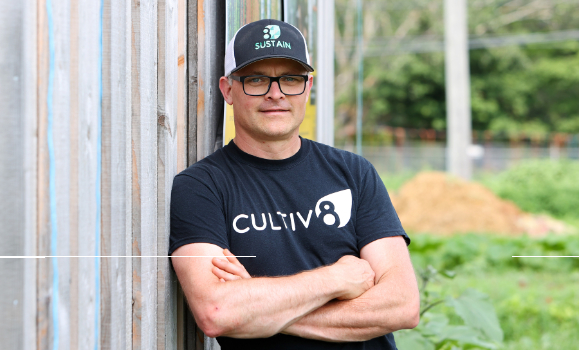 Jason’s support and expertise is invaluable to Cultiv8. A plant science (2011) and Master of Science (2013) graduate of the Faculty of Agriculture, he also has direct experience in ideation, creation and implementation in the value-added agri-food industry, having launched a line of gourmet habanero-based jellies called PepperHead in 2013. He knows the ropes well.
And his entrepreneurial spirit and determination shine through in the growth and success of Cultiv8. Taking on the role of manager in 2017, Jason has worked tirelessly since that time to expand Cultiv8’s programming and make it as applicable as possible to the real world.
“One of our overarching goals is to model solutions in food security and sustainability not only for our students, but eventually for local farmers as well,” he says. “We need to not only provide theory but provide an area for students to work on that theory. It’s crucial that we practice what we preach.”
Of the suite of offerings rolled out over the last few years, the largest and most impactful is undoubtedly the Sustain by Cultiv8 initiative.
Sustain by Cultiv8
“Under the essential service of agriculture, with a focus on food security and climate emergency reversal, we are building an inclusive, student-run economically sustainable vegetable and cut flower production market garden,” says Jason. “But the vision is more than that. Sustain is positioned to become a hub of students, teachers, research, industry and community.”
Sustain is an ambitious project, seeking to meet a large number of outcomes – but Cultiv8 is making good on them.
Not only does Sustain provide the opportunity for students to develop skills in sustainable vegetable production through hands-on experience, it also actually employs students. This summer there are five Sustain student employees, three of whom are interns, who, through this experience, also receive credit for the AGRI 2001 Internship course – the main objective of which is to help facilitate the development of the skills, knowledge, and experiences necessary to be successful in a workplace related to the student's area of study.
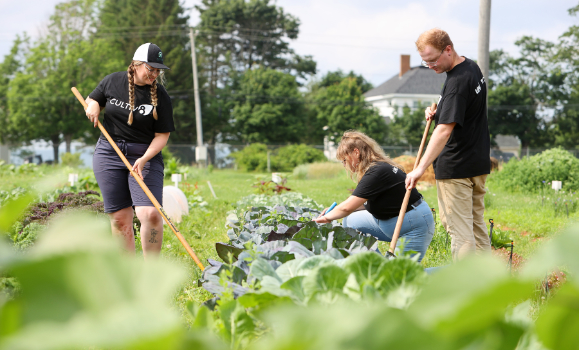 “We want to provide paid opportunities for students to explore,” says Jason. “They should feel empowered to work on their own projects individually as well as collectively as a team. Opportunities exist to enable students to intern, apprentice, conduct honours and grad projects, build involvement with community and explore value-added ag entrepreneurship.”
Luci Ellis, an agricultural business student, was employed as a Cultiv8 student intern in 2022. She has returned this season as the student team lead. “I had so much fun last year,” she recalls. “It was the best job I’ve ever had. The option to come back again this year and focus on developing managerial and leadership skills was an opportunity I couldn’t pass up.”
Amanda Whitford is heading into her second year of the plant science diploma and is working for Cultiv8 for the first time this summer. “Growing is a passion of mine, and working for Cultiv8 has been a great opportunity to expand my skills. I get to take things that I’ve learned in class and apply them on a scale I wouldn’t otherwise be able to.”
The unique interests of each of the interns employed this summer lend themselves well to this approach – one student has a specific interest in floriculture, one an interest in building awareness around community supported agriculture (CSA), and one an interest in social media and building an e-commerce platform. Together, they are advancing the awareness, efficiency and production of Sustain, which has already grown significantly since launching in 2020.
“Unfortunately, the pandemic hit during our first year of production,” recalls Jason. “But we had already started the work, so the silver lining was that we could donate all the vegetables grown that year.”
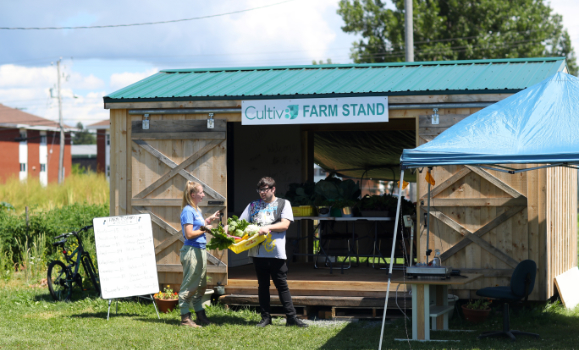 The first sales came the following year. In 2021, operating out of the demonstration garden on Pictou Road, Sustain sold farm gate vegetables to the public, wholesale vegetables to Chartwells, the campus food services provider, and was also able to provide donations to the Colchester Community Food Bank.
In 2022, Sustain added an additional sales option – a CSA subscription box. A total of 40 subscriptions were sold in 2022, with an additional 11 subscriptions donated to families in need via a partnership with United Way. The Sustain farm stand also installed a sales kiosk to streamline sales and provide further retail experience to students.
In 2023, garden sales and subscription boxes continue, along with donations to the food bank, United Way, and the Dal AC food pantry. To help with project continuity, recent agricultural business graduate John Raymond (Class of ‘23) has been hired as farm coordinator for the next three years while he pursues his Master of Science. A Cultiv8 student employee of several years, John’s research will contribute directly to Sustain as he examines entrepreneurship education ecosystems at agricultural campuses under the supervision of Tasha Richard of the Department of Business & Social Sciences.
“I’m going to be looking at the support systems for entrepreneurship specifically at university agricultural campuses,” says John. “My experience with Sustain and Cultiv8 made this an appealing project for me.”
Cultiv8 and Sustain have become embedded in the curriculum of many undergrad courses on campus as well, including Business Planning (MGTA 2013), Agricultural Ecosystems (AGRI 1000), Introduction to Plant Science (PLSC 1001), Advertising and Promotion (MGTA 2006), Specialty Crops (PLSC 2000), and Vegetable Production (HORT 2000).
Jason expects there will be more grad students contributing to Sustain through their research in the coming years – just one of the many outcomes Cultiv8 is working toward.
And it doesn’t end there.
Climate battery greenhouse
“We are actively working toward installing a 96’ x 30’ climate battery greenhouse, which will enable us to sustainably grow food year-round,” says Jason. “It will also allow our campus to do all sorts of amazing research in a climate-friendly environment.”
A climate battery greenhouse captures the heat of the sun and stores it underneath the greenhouse as a thermal mass, or battery. That heat can then be utilized as the outdoor growing season tapers off into sub-zero temperatures. According to Jason, there are existing successful climate battery greenhouses in the province, but they are not currently being used for research purposes. He is excited about the opportunities having a climate battery greenhouse will provide to students, instructors and researchers alike.
“The state of the climate emergency is such that we have to be very mindful and intentional about the decisions we make for our future of agriculture,” says Jason. “This greenhouse is another opportunity for us to model sustainable solutions for future and existing farmers.”
Cultiv8 CHEF
Sustain may be the most intensive and well-recognized Cultiv8 initiative, but it's certainly not the only one. Winter 2023 saw the launch of a pilot program called Cultiv8 CHEF, which was designed to allow students to learn valuable kitchen skills, food preservation basics and to have fun developing their own value-added food product.
Teaming up with Chef Reinier Boermans, a certified, European-trained chef with 20 years of experience, Jason intended the program to provide another avenue for students to learn about food security and product development.
“Successful food preservation contributes to food security. We wanted to bring back the ability to preserve products as essential skills in food security, and then we wanted to think a little beyond that into the value-added food product development area – a space which is exciting for entrepreneurs, foodies and consumers”, he says.
The pilot was a near sell-out with 12 participants. Students were introduced to kitchen basics, spent time following recipes to create products, and then teamed up to build their own recipes and products, seeking feedback and making improvements along the way.
Plant science student and Cultiv8 intern Cullen MacDonald participated in the pilot program. “I’m interested in food chemistry and figured we would get a chance to dig into that, but we learned so much more than I expected,” Cullen says. “We spent time looking at all the steps involved in taking an idea through to a final, finished product.”
Four student teams developed customized chutney recipes, and at the end of the eight-week program were tasked with presenting their recipe to a panel of judges, which Cullen says was lots of fun and quite interesting as well.
“It was fascinating to see the end results. Each team had the same information and received the same tasks, but came up with four very different products.”
One of the four chutney recipes will be used as part of the menu for the scholarship banquet coming up in November 2023.
Additional programming
Cultiv8 also provides opportunities for Faculty of Agriculture students to work with and learn from like-minded students from other universities. One such opportunity is another pilot program called Nova Nourishment.
With funding from the Department of Advanced Education, Cultiv8, along with the sandboxes at Saint Mary’s University, Acadia University, Cape Breton University and NSCC Digby will each hire four students per semester of the 2023-24 academic year to work toward understanding what the state of food sovereignty and security is on their respective campuses.
Each sandbox will work independently for the majority of the project, but students from all participating schools will get together for a few weekend events to collaborate and learn about what’s happening with each team. The students will be challenged to develop a prototype for their school that will improve food security on campus. If the program works well, it has potential to be rolled out at all sandboxes in the province.
And of course, Faculty of Agriculture students also have the opportunity to connect with students from other Dalhousie sandboxes. Known collectively as the DalBoxes, Cultiv8, IDEA (Faculty of Engineering), Surge (Faculty of Science), PULSE (Faculty of Health) and ShiftKey Labs (Faculty of Computer Science) provide collaborative opportunities throughout the school year.
Programming support
Financial support for Cultiv8’s programming has been enthusiastic – which is crucial, since all this essential work comes at a cost. Funded largely by the Department of Advanced Education, support from interested donors and revenue from garden sales has allowed Cultiv8 to grow, and partnerships with financial institutions have contributed to program longevity.
Donor support has been particularly strong for Sustain. It’s clear that alumni, staff, faculty, industry and community members see the value in this student-run initiative. Particularly after the pandemic, hands-on learning opportunities that bring together students, teachers, researchers, industry and community are more important than ever.
And of course, Sustain would not be possible without internal support from the Department of Plant, Food and Environmental Sciences, which provides both garden and greenhouse space, and particularly the expertise and guidance of agricultural technician Mike Main, who oversees the demonstration garden.
The community of Cultiv8
Jason’s vision for Cultiv8 to become a hub for community is already being realized through every collaboration, competition, donation, garden sale, and student interaction. The positive outcomes of Cultiv8’s programming are many, and not just for the students. Anyone who gets involved in Cultiv8 in even the smallest way is bound to benefit – both in the short and long term.
“These students are our future leaders,” says Jason. “We owe them the opportunity to develop knowledge, skills and passions that motivate them so that they become advocates for a sustainable future.”
With the support of the Cultiv8 community, their futures are looking bright.
_________________________________________________________________
Cultiv8 is growing a culture of food-secure, climate-responsible horticulture at Dalhousie’s Faculty of Agriculture.
By Allison Barss
Grace Ashworth says agriculture has always been an important part of her life. Now a third-year international food business student in the Faculty of Agriculture, she has fond memories of following her mother and father — both “Aggies” themselves — around their family farm at a young age, asking lots of questions. She also remembers sitting on milk buckets, playing with the kittens and calves.
It wasn’t until Ashworth was 15 and moved away from home to attend high school that she realized what she was missing. “I quickly realized I wanted agriculture to be a part of my life and took interest in discovering my own role in the industry,” she says.
That’s when her own experiences led her to Dalhousie’s Faculty of Agriculture and back to her roots, helping her discover who she is on — and off — the farm.
Cultiv8-ing from the ground up
During her second year at Dalhousie, Ashworth was introduced to Cultiv8, a donor-supported, student-driven initiative that offered her opportunities, skills and experiences to have an impact in the food and agricultural space.
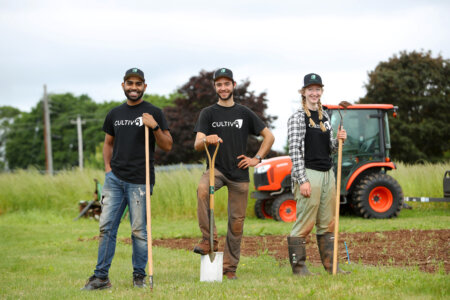
Grace Ashworth (right) and members of the Cultiv8 team receive support from the ground up. (Nick Pearce photo)
Through the program, she learned about sustainable growing practices working with a vegetable garden and greenhouse, and fine-tuned entrepreneurial and innovation skills. Ultimately, she says the experience bridged the gap between her education and real-world, hands-on work.
Agriculture alum Jason Grant (Class of 2011, MSc’13), manager of Cultiv8, says the program supports students like Ashworth from the ground up. “Cultiv8 lets students explore their interests and their potential,” he says. “It’s an incredible opportunity for them, allowing them to play and experiment in the field, and rub elbows with industry experts.”
Grant also shares that the project has become an essential service for the Agricultural Campus.
“Looking at the state of the world, food security-wise, the food we harvest from the vegetable garden continues to help supply a local food bank, a farm box subscription program, as well as on-campus services. We’re all grateful for that.”
Helping hands from donors
Cultiv8 is one of Dalhousie’s five sandbox programs brought to life as the result of generous donor support — from individuals, community sponsors and large corporations alike. This includes TD Bank and RBC, who have been instrumental in getting Cultiv8 off the ground.
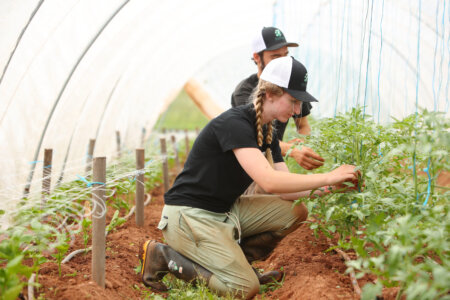
Cultiv8 allows students to operate a vegetable farm and food stand where they can confront real world issues. (Nick Pearce photo)
Specifically, as part of TD’s Ready Commitment — a funding initiative which supports programs that bring people together, offering resources and providing meaningful solutions for a sustainable and inclusive future — the financial services corporation has committed to a gift of $250,000 over 10 years to help support entrepreneurial programming facilitated by Cultiv8. Its intention is to further inspire students to engage in skills development for the modern-day, agricultural workforce.
“Through the Ready Commitment, TD is proud to support initiatives like Cultiv8 that prepare people for the jobs of tomorrow,” says Jennifer Auld, Vice President, Atlantic Region of TD Canada Trust. “Equipping students with employable skills positions them to succeed in their careers and ultimately address issues we face today and in the future. We are excited to be a part of this program and contribute to a more sustainable tomorrow.”
Community member and Agriculture alum Dale McIsaac (Class of 1973) is also a proud supporter of Cultiv8, and says it was his late son Ben who first encouraged his involvement.
“Ben knew that I had been involved with agriculture my entire life and that I was a believer in ‘local food’, in promoting food security in the Maritimes and Canada, and in learning how to feed the world’s populations,” he says. “Cultiv8 was a natural fit for me, and I am so pleased to have been able to help Dalhousie, the program and the students achieve their goals.”
Reaching goals, together
After months of remote study during the pandemic, Grant says that hands-on learning opportunities — like those offered through Cultiv8 — are more important than ever.
“Thanks to the community’s support, we help students not just create projects, but actually roll them out,” says Grant. “These opportunities bring students, teachers, researchers, industry and the broader community together.”
Ashworth agrees. “The confidence I’ve developed and the growth mindset that I’ve fostered [through Cultiv8] will continue to help me as I pursue my education and career in agriculture,” she says. “I’m grateful for the kindness of Dalhousie’s donors, whose generosity has allowed students like me to partake in these unique, hands-on learning experiences. I’m confident that through this continued generosity, others will be offered similar experiences, helping to build and shape successful futures.”
For more on the Cultiv8, please watch this video: